Six Hundred Bucks, Zero Regrets: We Built a Full Race Buggy Out of Strangers' Castoffs
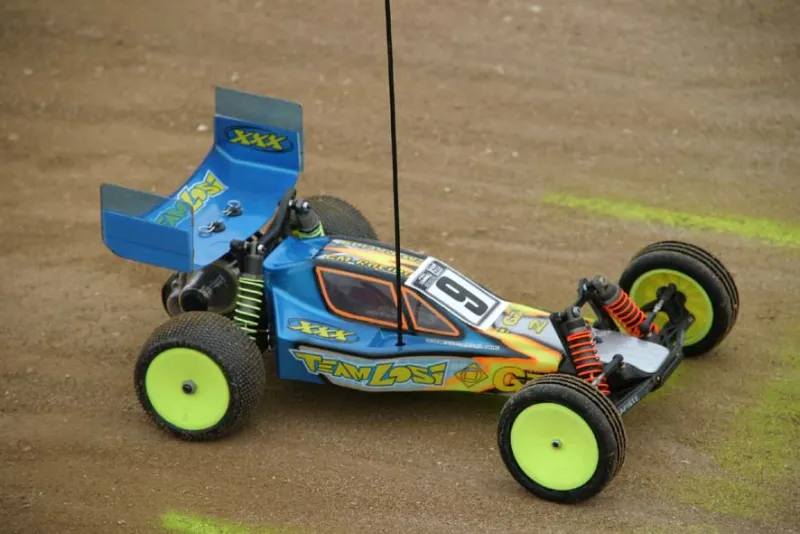
Photo: Benutzer:Kookaburra, Public domain, via Wikimedia Commons
Every RC racer has scrolled Facebook Marketplace at midnight, staring at a listing titled 'buggy PARTS LOT???' with three blurry photos and a price that's either a steal or a trap. We decided to find out which one it usually is.
The challenge: build a fully competitive 1/10 buggy for club racing using only secondhand parts. Marketplace, eBay, the swap meet table at our local indoor track in Ohio — all fair game. Budget cap: $600. The benchmark: a brand-new kit build that runs about $1,200 once you add electronics.
Here's how it went down.
The Haul: What $600 Actually Buys Used
Week one, we struck gold. A guy two towns over was selling a rolling chassis — a well-loved but straight-framed buggy with a handful of spares — for $180. He was getting out of the hobby because his kid discovered travel baseball. We've all been there.
From there, the build came together in pieces:
- Rolling chassis + spares: $180
- Motor (used, 13.5T, dyno numbers unknown): $45
- ESC (two generations old, firmware flashed): $60
- Servo: $30
- Radio + receiver: $75
- LiPos (two, lightly puffed inspection passed): $90
- Tires, wheels, body, misc. hardware: $120
Total: $600 even. We may have done a little victory lap in the garage.
The Scams, Near-Misses, and One Very Sketchy Battery
Let's be honest about the downside: the secondhand market is a jungle.
Our first motor 'deal' was a photo stolen from a hobby shop's website. Reverse image search caught it in ten seconds — always do this. Another seller listed a 'race-ready ESC' that turned out to be a brushed unit from 2011.
The scariest moment was the batteries. One pack arrived with a slightly swollen edge that the seller's photos conveniently cropped out. It went straight into a fireproof bag and then to an LiPo drop-off. Never cheap out on batteries. If the photos don't show every side of the pack, walk away.
We also learned to ask for a video of electronics powered on before sending money. Every serious seller we dealt with was happy to oblige. The ones who weren't? Exactly who you think they were.
The Hidden Gems Nobody Prices Right
For every scam, there's a steal. Our best find: a complete set of near-new treaded tires for $25 because the seller 'didn't like how they felt.' They felt like a main-event tire compound to us.
Swap meets are the real cheat code. At the track swap table, you can physically inspect gear, and sellers price to move — nobody wants to haul spares home. We picked up our radio there from a guy upgrading to a new rig, and he threw in a receiver for free because we shot the breeze about the local points series.
Race Day: Franken-Buggy vs. The Shelf Queens
So can a $600 used build hang with a $1,200 fresh one?
Short answer: yes, with caveats. At our club race, the Franken-buggy qualified mid-pack and made the B main. The lap times were within a second of the newest kit in the field — the difference was almost entirely the driver, not the hardware.
The caveats showed up in durability. A used diff went soft after two tough mains, and we burned through a set of used drive pins. Expect to spend another $50–75 in replacement wear items in your first month. That's still half the price of a new build.
The Verdict
If you're patient, know what to look for, and don't mind a little detective work, the secondhand economy is the fastest on-ramp into competitive racing we've found. Buy the chassis in person when possible, never gamble on batteries, and treat every 'too good to be true' listing like it's exactly that.
Our rookie racer got a full race buggy, a spare parts bin, and $600 left in his wallet. The shelf queen got dusted — at least in the B main.