We Launched a Race Buggy Off a Loading Ramp Until It Broke — Here's the Autopsy
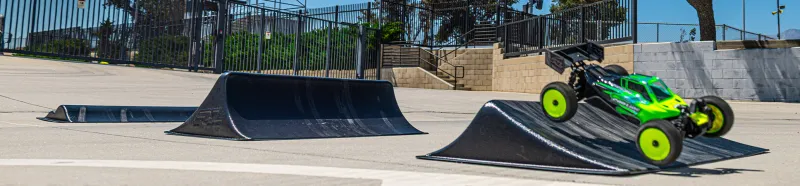
Photo: RC buggy jump ramp dirt action shot, via images.contentstack.io
Every racer has a theory about what breaks first. Ask around the pit table at any club race and you'll get a different answer from every guy holding a hex driver: the diff outdrive, the front arms, the hinge pins, the servo saver. We got tired of guessing, so we ran the experiment.
The rules were simple. One race-spec buggy — our usual club racer, nothing specially armored. One 10-foot loading ramp borrowed from a buddy's F-150 setup. Jump it from increasing heights until something gives. Document everything. Fix whatever breaks, log the cost, then go bigger.
Jump One: The Confidence Builder
We started at about three feet of drop from the ramp lip to the dirt. Honestly, this was a non-event. The buggy cased it once, flexed, and kept running. Landing gear took the hit like it was a Tuesday practice session. Total damage: zero dollars. Total damage to our egos: also zero, because we're used to casing jumps.
Jump Two Through Four: The Grey Zone
Bumping to five and then six feet is where things get interesting. This is the height where bashing and racing part ways. A race buggy is tuned to land on a groomed surface with a predictable launch angle. A loading ramp onto hard-packed Texas clay is neither groomed nor predictable.
At six feet we started seeing the telltale wobble — a slight tweak in the front end after each landing. Slow-mo footage showed the front suspension cycling to its stops and the chassis bottoming out on the landings. Nothing broke, but we were on borrowed time. Running repair total: still zero, but the arms were visibly stressed near the hinge pin holes.
The Break: Eight Feet, One Diff Outdrive
At eight feet, it happened. The buggy nose-heavy cased the landing, the rear end loaded up, and snap — the diff outdrive sheared clean at the spline. On the slow-mo replay you can actually see the rear wheels stop driving a half-second before the buggy cartwheels. That's the moment the outdrive gave up so the drivetrain didn't have to.
And honestly? That's exactly what a sacrificial part is supposed to do. Repair cost: $12 for a replacement outdrive and a fresh diff gasket. Twenty minutes with the wheel wrench and we were back in business.
Budget Parts vs. Race Parts: The Verdict We Didn't Expect
Here's where we went off-script. We had a spare roller with budget arms and a knockoff diff on the shelf, so we ran the same eight-foot jump for science. The cheap arms snapped on the second landing. Not tweaked — snapped. And the knockoff diff stripped its internal gears so thoroughly that the buggy just spun in circles like a dog chasing its tail.
So do race-grade parts survive bashing better? Yes, but not in the way most people think. The race parts didn't avoid breaking — they broke later and broke cheaply. A $12 outdrive is a designed failure point. A snapped budget arm takes out the shock tower and the body clips on the way down.
What We'd Tell You Over the Pit Table
If you're going to bash a race buggy — and look, we're not your dad, go ahead — do three things. First, keep spare outdrives and hinge pins in the box, because that's where the physics lands. Second, land on dirt, not asphalt; the difference in impact force is not subtle. Third, film everything in slow-mo, because the failure frame is genuinely the best part.
Total bill for the day: $12 in parts, one borrowed ramp, and a buggy that's already back on the track. Was it a smart use of a Saturday? Our wives say no. Our YouTube analytics say absolutely.
We'll be running the truggy version next month. Bring popcorn.