Your Lawn Is a Raceway Waiting to Happen: A Backyard Track Blueprint That Won't Rile the HOA
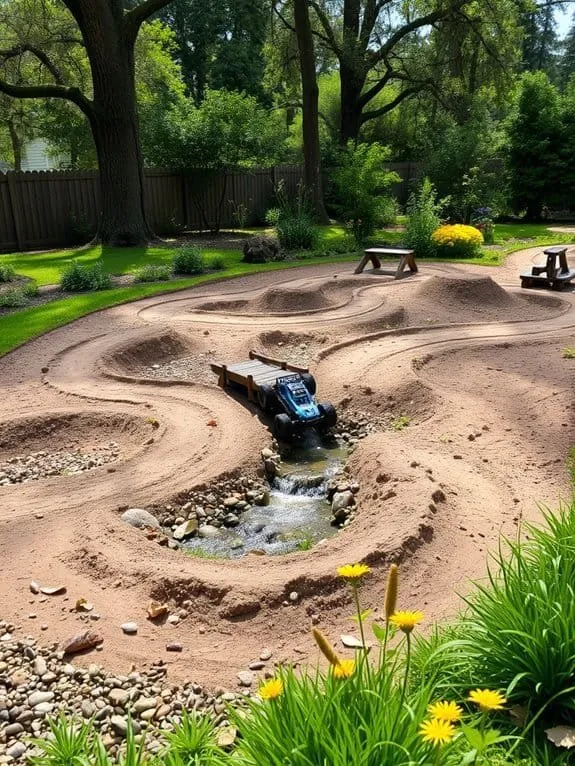
Photo: backyard RC car dirt track with jumps in suburban yard, via lushbackyard.com
Somewhere between your third lap around the cul-de-sac and your kid asking why the car 'keeps going in a straight line,' it hits you: the backyard is wasted space. Flat grass, zero character, no jumps. It's begging to become a track.
Good news — it can happen in a weekend or two, for less than the cost of a set of pro tires. Better news: it can happen without a letter from your homeowners association. Here's the blueprint, learned partly through trial, partly through error, and partly through a very patient neighbor named Doug.
Start With the Layout, Not the Shovel
Before you dig anything, grab a garden hose and lay it on the grass in rough loop shapes. This is the cheapest design tool in RC — you can reshape your entire track in thirty seconds without moving a single scoop of dirt.
Aim for a loop between 40 and 80 feet across depending on your yard. Anything tighter and your 1/10 scale buggy spends the day doing pirouettes; anything bigger and you'll be mowing a parade route. Mix it up: one fast sweeper, one hairpin that punishes overconfidence, one section of whoops made from a row of small mounds.
Pro tip from the crew: walk the layout at your car's eye level. Crouch down. What looks like a gentle rise standing up is a mountain range when you're two inches tall.
Drainage or Regret — Pick One
Every backyard track builder learns this lesson exactly once. Water pools in your ruts, and suddenly your pristine circuit is a mosquito breeding facility with a mud pit in turn three.
Build your track slightly crowned — a gentle slope of an inch or two from centerline to edge — so rain runs off instead of settling in. If your yard has a natural low spot, work with it: put your biggest jump near the high ground and let the low corner double as a designated puddle section. Some of us deliberately design a wet corner. It's called character.
Jumps That Actually Launch (Without a Dumpster Full of Dirt)
You don't need an excavator. A flat-blade shovel, a wheelbarrow, and a stiff rake will get you there.
For a solid tabletop, pile dirt into a long mound about 12 to 18 inches tall, pack it with your feet (or a hand tamper if you're fancy), then shape the takeoff at a gentle angle and the landing steeper and wider. Wide landings save race nights — nothing ends a heat faster than a one-inch-wide landing lip that eats your rear endplate.
Budget hack: use free fill dirt from local Facebook Marketplace or Craigslist listings. Landscapers give it away constantly. Bring your own buckets, say thank you, and you've got jump material for zero dollars.
Cheap Lap Timing That Actually Works
You've built the thing — now you need bragging rights that hold up in court. Options, cheapest first:
- The honor system: a buddy with a stopwatch. Free, occasionally inaccurate, always disputed.
- Phone apps: several lap-timer apps use the camera or manual taps. Good enough for neighborhood grudge matches.
- DIY IR lap gates: hobbyists have built infrared timing loops with a Raspberry Pi and an IR transceiver for under $60. There are open-source projects floating around with full parts lists. This is the move if you host regular race nights.
- Transponder systems: the real deal, but you're now spending more on timing than on the track. Save it for when you go pro. Or when Doug starts cheating.
Keeping the Neighbors (and the HOA) Off Your Back
Here's the honest truth: most HOAs don't have a rule against RC tracks. They have rules against visible mess, noise, and unapproved structures. Play to that.
- Noise: electric brushless setups are whisper-quiet. If you're running nitro in a suburban backyard at 9 PM, the HOA is the least of your problems.
- Visibility: a low-profile track reads as landscaping. Keep berms under 18 inches and plant a border of ornamental grass if you're nervous. Suddenly it's a 'garden feature.'
- Condition: fill and re-grade your ruts monthly. A maintained track looks intentional; a rutted one looks like a code violation.
And the single best HOA shield we've ever found? Invite them. One of the hobbyists we talked to for this piece hosts monthly Friday-night race nights — lawn chairs, a fire pit, kids marshaling with pool noodles. His HOA president has a transponder now. You can't file a complaint against a guy who owes you a rematch.
Race Night, One Month In
Two weekends of shoveling, one Amazon order, and a bag of fast-set concrete for the corner markers later, you'll have something that feels legitimately like a track — right turns, lap times, a jump that launches just right when you hit the lip clean.
Will it replace the local club circuit? No. Will it make your backyard the most popular patch of grass on the street and sharpen your throttle finger between race days? Absolutely.
Now if you'll excuse us, Doug's got a two-tenth deficit to answer for.