Dial In Before You Buy: How Radio Setup Turned Our Mid-Pack Guy Into a Podium Regular
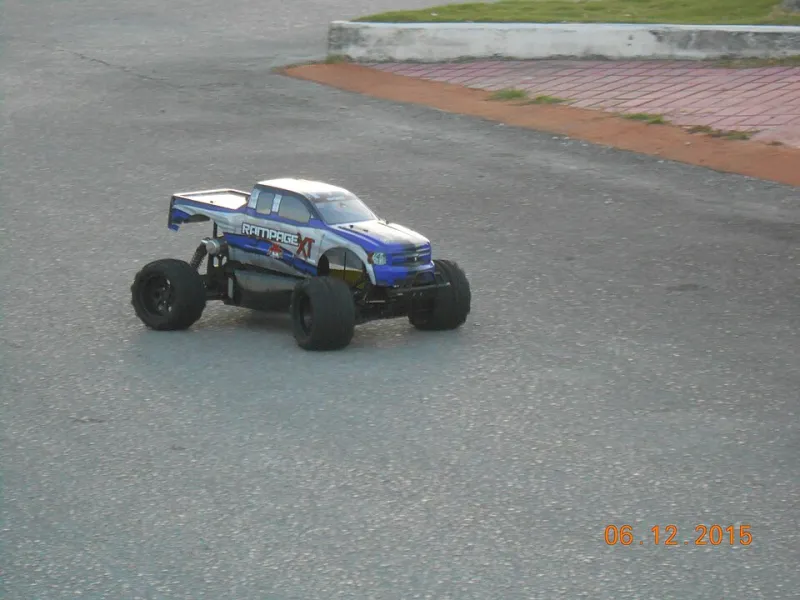
Photo: Editor abcdef, CC0, via Wikimedia Commons
Every club has that guy. Ours is Dave. Solid lap times, clean driving, perpetually finishing fifth through eighth while guys with identical hardware walk away with trophies. Dave kept blaming his motor. His ESC. His servo. Six months and a couple hundred bucks later, he was still mid-pack.
Then one Tuesday night, our team tuner grabbed Dave's transmitter, spent twenty minutes in the menus, and handed it back. Two race days later, Dave took second in the A main. Nothing on the car had changed. Not one part.
That's the dirty secret of club racing: most of us are losing time in our radios, not our drivetrains.
Why the Radio Is the Most Ignored Upgrade
Walk the pits at any regional race and you'll see $700 power systems bolted to cars driven with factory-default radio settings. Meanwhile, the fast guys are running $100 transmitters with carefully shaped throttle curves. The hardware arms race is fun, but it doesn't fix the actual problem — most drivers can't modulate a raw, linear throttle response smoothly for a full five-minute heat.
A programmable radio lets you reshape how the car responds to your fingers. That's not a luxury feature. For anyone who isn't a pro, it's the difference between driving the car and fighting it.
The Four Settings That Actually Matter
Throttle Curve (or Throttle Speed/Expo on throttle): A curve softens the initial throttle punch so you can roll on power out of corners instead of snapping loose. Most radios let you set a positive expo value on the throttle channel — start with 20% and adjust from there.
Steering Expo: Same idea, but for the wheel. If your car feels twitchy on straights, steering expo around 15–25% makes the center of the wheel travel less sensitive while keeping full lock when you need it.
Dual Rate: This caps your maximum steering travel. Too much steering throw causes hooking and traction rolls. Back it down until the car turns enough for the tightest corner on your track, then stop. More is not better.
EPA (End Point Adjustment): This sets how far your servo and throttle/brake actually travel. On the throttle side, dialing back your brake EPA can stop those panic lock-ups that send you wide in turn one. On steering, correct EPA protects your servo from binding — a stripped servo gear is a $40 mistake that proper endpoints prevent for free.
The 20-Minute Garage Setup
Here's the exact routine we walked Dave through. Works on basically any programmable radio from Spektrum, Futaba, FlySky, or Radiomaster:
- Set steering EPA first. Turn the wheel full left, then full right. Adjust endpoints until the servo stops but never buzzes or binds. Do this before anything else.
- Add 20% steering expo. Drive five laps. If the car still darts around on straights, go to 25%. If it feels dull in sweepers, drop to 15%.
- Trim dual rate down. Start at 100%, then reduce in 5% steps until the car just barely makes your track's tightest corner. That's your number.
- Set 20% throttle expo. This is the big one for most drivers. The goal is a softer first third of trigger pull so you can feather power through the corner exit.
- Reduce brake EPA if you lock up. If your rear end steps out under hard braking, pull brake endpoint back 10–15% and retest.
- Write it down. Save it as a model profile. When you change tracks or conditions, you adjust from a known baseline instead of starting over.
What Changed for Dave
The honest breakdown: Dave didn't get faster hands. He got a car that stopped overreacting to them. Softer initial throttle meant fewer spinouts in the hairpin. Tamed dual rate meant fewer traction rolls in the sweeper. His lap times didn't get dramatically quicker — his worst laps got dramatically better, and in club racing, consistency is what moves you up the order.
Since the fix, we've run the same experiment on three other drivers in the series. All three picked up positions. One of them, a guy who'd been about to drop $250 on a new ESC, canceled the order and bought a set of tires with the money instead.
Before You Buy Another Part
Next time you're tempted to throw hardware at a lap time problem, plug your transmitter into a bench and spend an evening in the menus first. It's free, it's reversible, and unlike a new motor, it teaches you something about why your car does what it does.
The fast guys at your track probably figured this out a while ago. Now you have too — and it cost you nothing but twenty minutes and a little humility in the model menu.
See you in the A main, Dave.